
Thursday, November 30, 2017


Thursday, June 22, 2017
BAT7 Reported Swiftlet farming booming in Tatau
SIBU: Without realising it, this is the last leg of BAT7’s two-week roadtrip, which has covered over 2,000km up north and back.
Initially, we planned to head to Sarikei from Bintulu but due to ongoing heavy construction works along the Pan Borneo Highway and also the all-day heavy rain yesterday which slowed our journey, we made Sibu our pitstop in order to meet the deadline.
Along the way, we stopped by at Tatau – a small town about 56km from Bintulu town – for lunch where we discovered a lot of swiftlet farming activities being carried out in commercial buildings. Upon reaching the town, we were welcomed by the bird's chirping – both recorded and natural – of the swiftlets around there.
When asked for their comments, the locals seemed to be oblivious to the noise pollution created by these swiftlets. One of the townsfolk, who preferred anonymity, simply said: “We’re used to it – what can we do; we have to get used to it.”
Another resident, who operates a coffee shop, appealed to the relevant authorities to get rid of these swiftlet farms in commercial buildings for various reasons.
A source close to the matter revealed that such business endeavour was flouting the law.
“Firstly, shophouses should not be used as or turned into swiftlet farms for it is against the law of land or building use in Sarawak. And secondly, it is operated illegally without licence, which should be issued by the controller of wildlife,” the source told BAT7 yesterday.
The source also revealed that in some towns across Peninsula Malaysia such as in Taiping in Perak, the authority there allowed such activity to take place in commercial buildings.
“But here in Sarawak, we have to be careful as it may pose hazard to public health, especially diseases which can be transmitted by birds. So we have to take preventive measures by stopping this illegal activity.
“So our hope now is for the key agencies to enforce the law,” the source emphasised, adding that swiftlet farming should be conducted at least 10km away from town and conducted on agriculture land in accordance with the present guidelines.
Saturday, June 10, 2017
Myanmar’s edible bird nest industry comes home to roost
BOKPYIN, Myanmar (AFP) – The cries of amorous swiftlets echo around the dark room, an unlikely gold mine for traders in southern Myanmar who are cashing in on rising demand for the edible nests from China’s growing middle class.
Dozens of buildings dedicated to the tiny birds have sprung up around Bokpyin in recent years, their grey concrete structures towering over the humbler wooden and brick homes of the town’s human inhabitants.
Every morning and evening the air is filled with high-pitched twitterings blasted from loudspeakers that draw thousands of the swallow-like birds home to roost.
Edible birds nests have become one of the main industries in the town, traditionally known for producing the chewable stimulant betel nut as well as rubber and palm oil.
Traders can charge around $2,000 a viss (equivalent to 1.63 kilogrammes) for the tiny nests – more than the average person in Myanmar earns in a year.
“We started making man-made bird nests (houses) 10 years ago,” said Paing Set Aung, who owns one of the buildings where hundreds of swiftlets make their homes in the rafters.
“Initially there was a house where the birds came to roost by themselves. After that, people started to construct man-made bird houses.”
Most of the tiny white nests, which are made from solidified bird spit, are sold to neighbouring China.
Long considered the reserve of the country’s wealthy elite, who ate them during lavish banquets, they are in increasing demand from middle-class consumers.
Today the global edible birds nest industry is estimated to be worth $5 billion, most of it produced in Southeast Asia.
Myanmar’s exports have surged since 2011 – the year the former junta handed over power to a quasi-civilian government.
“Bird nests are one of the main businesses in Bokpyin,” said local Lin Aung, who built his first house five years ago and is now on his third.
“China is the top buyer of bird nests here.”

When boiled in water the nests dissolve into a gelatinous gloop which is then made into desserts or drunk as a soup or a tonic that is said to prolong life and improve strength. – PHOTOS: AFP

In Shanghai, restaurants sell dishes made from the nests, known as ‘the caviar of the East’ for hundreds of dollars a bowl

Once across the border, the nests are transformed into one of the most expensive foods in the world.
When boiled in water they dissolve into a gelatinous gloop which is then made into desserts or drunk as a soup or a tonic that is said to prolong life and improve strength.
There is little peer-reviewed scientific data showing that nests have proven medicinal properties.
Nutritional studies have shown the saliva to be mainly made up of protein, followed by carbohydrates.
In Shanghai restaurants sell the “the caviar of the East,” as it is known, for hundreds of dollars a bowl.
Many of them cater specifically to women, who believe the nests can help smooth the complexion and make them look younger.
The tonic is also said to help during pregnancy – one of Shanghai’s high-end spas solely for mothers-to-be even has its own restaurant and sells gift bags for as much as 3900 RMB ($566).
Shoppers can also order the products online, including candied birds nests from Myanmar to be eaten as sweets.
“In China, the bird nest has been a really famous and much-loved traditional tonic since ancient times,” Zhang Yi told AFP inside her NestCha restaurant.
“It is mild and a little sweet. It is good for women, the elderly, children and men.”
These luxury products are a far cry from the nests’ humble beginnings on the islands of Myanmar’s southern archipelago.
To begin with they were harvested on the region’s many islands by daring climbers who risked life and limb scaling treacherous cliffs without any safety equipment.
For years the industry was dominated by the Union of Myanma Economic Holdings Ltd (UMEHL), a sprawling conglomerate controlled by the military elites that ran Myanmar for half a century.
But, as in much of Southeast Asia, production has increasingly moved into urban centres.
Locals in the southern city of Myeik started building houses to attract the birds decades ago, then later production spread to Bokpyin and nearby Kawthaung.
There are now more than 130 houses devoted to the swiftlets dotted around the region, according to state media.
Competition for space in Bokpyin between bird nest producers and tourism developers has seen land prices surge to as high as $75,000 a plot in downtown – on a par with parts of the commercial capital Yangon.
Nests are normally harvested three or four times a year, but traders can collect them often as once a month if they are in need of cash.
Producer Aung Kyaw Moe said that, because the swiftlet populations naturally increase as the birds become accustomed to their homes, the industry will only grow in the coming years.
“They are like humans because they come and live here after they get to know the place,” he told AFP, standing next to his tall wooden bird-house in Myeik.
Happy days are back again for bird’s nest traders
KUCHING: With higher demand and lower supply, the bird’s nest industry is now experiencing a boom with a kilogramme of untreated bird’s nest now fetching RM3,000 to RM3,200, and treated ones, RM4,000 to RM6,000.
Sarawak Bird’s Nest Import and Export Association president Liu Thian Leong said prices of bird’s nest have been surging for more than half a year.
“Demand is high now. There are many freelance traders in the market. And these traders have been going around looking for either raw or unprocessed bird’s nest as well as processed ones,” Liu told The Borneo Post yesterday.
He said the ban from China is still on but the regulation seemed to be more relaxed.
“China still insists on certain criteria but in general, these regulations are no longer that stringent.”
“There are now Chinese traders who will make the trip here personally to buy the bird’s nest. Then there are local traders who are exporting direct to China, while others may export to China through Hong Kong, the global bird’s nest centre.”
“Through some ways or some means, our local bird’s nest still manage to get into China. Business is really good now and it is getting better,” Liu said.
Liu noted the low supply of bird’s nest is due to diminishing supply from swiftlet farms in urban areas.
“The production of swiftlet farms in town areas are showing a general decline. This means bird’s nest production in urban centres such as in shophouses are producing less but those in rural areas are showing positive growth. There are many new players coming into the markets while there are some who are phasing out. But in general, this is really a good time for swiftlet farmers,” said Liu.
He said the bird’s flu outbreak in Kelantan during January and February did not affect the bird’s nest industry in Sarawak adversely.
“Traders and farmers in Peninsular Malaysia were affected for a while as bird’s nest import from Peninsular Malaysia to China was banned. However, the whole short bird’s flu incident did not affect Sarawak or damage the market,” said Liu.
It has been estimated that each year, Sarawak bird’s nest traders, through e-commerce or export to China or Hong Kong, export about 60 tonnes of bird’s nest.
In Sarawak, bird’s nest is considered a forest product and the bird’s nest industry has been under the Forest Department. According to Malaysian Agreement 1963, forestry, like land, is fully under the jurisdiction of the state government, independent from the federal government.
Presently, bird’s nest traders or farmers who export through proper channel pay RM50 in tax for every kilogramme. Based on RM50 per kilogramme, it means bird’s nest trading can contribute RM3 million in tax for the state coffers.
Borneo Post


China lifts temporary ban on Malaysia's clean, edible bird's nest
PUTRAJAYA: As Kelantan is recuperating from the H5N1 (Bird's Flu) outbreak, China has lifted its temporary ban on clean, edible bird's nest imported from Malaysia, confirmed the Department of Veterinary Services (DVS).
Its director-general Datuk Dr Quaza Nizamuddin Hassan Nizam said he's met his counterpart in Beijing recently and the Chinese government had agreed to lift the temporary ban on the import of clean edible bird's nest from Malaysia.
Nineteen bird's nest processing plants will benefit from this move, with an estimated market worth RM134 million a year in China.
"The condition set on us is that all our processing plants must use the heat treatment in processing the bird's nest," said Dr Quaza, adding there must also be training on the proper procedures for the heat treatment."
The Chinese officials had also visited several of the plants, he revealed.
"I will issue letters of certification to all 19 processing plants so that they can start exporting clean bird's nest to China again," he added.
Malaysia is currently the world's second largest producer of bird's nest after Indonesia, producing an estimated 25 tonnes per month.
Based on earlier reports, the swiftlet farming industry is expected to contribute RM4.5 billion to the country’s gross national income by 2020.
However, Dr Quaza said China had yet to approve the import of raw, uncleaned bird's nest from Malaysia.
Saturday, March 11, 2017
Protocol to export Raw Unclean
KUALA LUMPUR: The Agriculture and Agro-based Industry Ministry is setting up a platform to ensure that raw and uncleaned edible bird’s nests (RUCEBN) which are exported to China comply with agreed standards, said its minister Datuk Seri Ahmad Shabery Cheek.
He said the standards are under a protocol that was agreed upon during Prime Minister Datuk Seri Najib Razak's visit to China recently.
Shabery said the platform will be completed in six months, and that all RUCEBN traders must comply with the regulations and meet requirements set under the protocol of inspection, quarantine and veterinary hygiene.
"In the past three to four years, we have seen cases where the exported products contained unsafe ingredients – but through the protocol, the Veterinary Services Department would set certain standards to be met before the products are sent to China.
"We will ensure that the products are of quality, as they (the traders) are required to comply with 35 terms and conditions set in the protocol," he said during Minister's Question Time in Parliament today.
Shabery was replying to Datuk Dr Shamsul Anuar Nasarah (BN-Lenggong)’s question about the swiftlet bird export agreement with China after Najib's recent visit.
The protocol, Shabery said, will avoid the export of poor quality products and help traders generate sustainable income.
Thursday, January 26, 2017
Wednesday, January 18, 2017
Wing Shen calls on govt for aid in bird’s nest sector

KUCHING: Wing Shen Food Industries Sdn Bhd (Wing Shen), an established bird’s nest manufacturing company, hopes for for Sarawak government assistance in encouraging the growth of bird’s nest farming industry.
According to managing director Wong Nguie Jin, there is a shortage of raw materials in Sarawak which needs to be addressed by the government.
Previously, Wong noted that Jabatan Kebajikan Masyarakat (JKM) had conducted a course for bird’s nest farmers to build the farms (birdhouses) way back in 2007.
The course provided farmers with the techniques, support and knowledge necessary for them to build the birdhouses and ways to attract the swiftlets to come to nest in these buildings.
The course from JKM was planned and was considered a success as many farmers managed to harvest these raw materials and sell the goods to Wing Shen.
However, unprocessed bird’s nests is still short in supply given the huge demand for the finished products overseas.
As such, Wong hopes that the government can support this industry by encouraging farmers to join in the bird’s nest farming business. These can be subsidies for more training courses which can then be used for their food and accomodations during the course period.
“Income from these bird’s nest farming can incur up to even RM5,000 per month,” he said.
Wong stressed that this thriving industry can create more working opportunities for locals in Sarawak. Moreover, as this business has high earning potential, farmers who retire later will have less financial burden during their retirement.
Generally, Wong believed this industry can create more employment opportunities for locals in Sarawak.
“The working population will increase as when they have the farm, they will hire employees to help harvest the bird’s nests,” he explained.
As Wing Shen is involved in the downstream side of the bird’s nest industry, the company is also in need of employees as it relies more on manpower instead of machineries when processing the bird’s nests.
Currently, there are only three companies in Sarawak authorised to export to China, including Wing Shen. Two of these firms are in Kuching while the other is in Mukah.
These three companies are currently only able to supply 300 kilograms of bird’s nest per month to China, which Wong reiterates is not enough.
Malaysia’s supply of processed bird’s nest to China amounts to at least five tonnes per month.
“In Malaysia, in one month, we can only collect 20 to 30 tonnes of unprocessed bird’s nest which is still not enough,” he said.
Aside from China, which makes up 70 per cent of the company’s exports, Wing Shen also exports its products to Taiwan, Canada, US and Australia.
Borneo Post
Model of small scale swiftlet house measuring 12 x 24
Monday, January 9, 2017
Small Scale Swiftlet Ranching in the rural
This type of swiftlet premises measuring 12'x24'x16' high is capable of producing 1 kg edible nest per month. Project started in year 2010 and by 2017, production increase steadily.


Tuesday, December 27, 2016
Wednesday, November 23, 2016
Price of raw unclean bird's nest may increase
Bird’s nest export prices are expected to quintuple after Malaysia inked a deal with China to ship raw edible nests to the People’s Republic.
Malaysia’s deal with China, said Malaysia’s Agriculture and Agro-Based Industry Minister Datuk Seri Ahmad Shabery Cheek, could bring about RM1.5 billion (US$340,456,560) in profits to the local bird’s nest industry, but this could also mean the price for the product for local consumption may increase.
The deal, called Protocol of Inspection, Quarantine and Veterinary Hygiene Requirements for the Exportation of Raw, Uncleaned, Edible Bird’s Nest, is everything the name suggests.
The protocol sets standards for Malaysia’s 10,000 bird’s nest farmers to sell their raw product to the ministry, which will then export it untouched to China, where it will be processed and cleaned in Qinzhou and then sold to the Chinese market.
Malaysia has a RM22 million (US$4,993,363) joint quarantine, processing and testing plant with China in the Qinzhou Industrial Park.
China banned imports of bird’s nests from Malaysia in 2011 after finding nitrate in some of the nests.
“Everything will go through us and we will make sure this will be certified under standards we agreed on with China,” Ahmad Shabery said in the Parliament lobby yesterday.
He said when China imposed the ban, the price of Malaysia’s bird’s nest dropped from RM8,000 (US$1,815.80) per nest to less than RM1,000 (US$227.20) and this put constraints on local farmers.
“This deal gives a good message with the possibility of boosting our price to RM3,000 (US$680.80) or maybe even RM5,000 (US$1,134.60),” he said.
There are about 20,000 registered bird’s nest farms in the country and each requires an investment of up to RM300,000 (US$68,091.30) from the farmers.
A hike in the price for their product would ensure the survivability of the industry, Ahmad Shabery said.
During a question-and-answer session in Parliament with Datuk Dr Shamsul Anuar Nasarah (Umno-Lenggong), Ahmad Shabery also discouraged farmers from trying to process bird’s nest themselves, as the results could be disastrous in terms of quality control.
“Now we have a platform to do everything legally that fulfils quality standards, so what happened three-years ago won’t happen again,” he said.
Malaysia produces about 300 metric tonnes of bird’s nest annually.


Sunday, November 20, 2016
Swiftlet houses in Sibu
These picture was taken when I stayed at RH Hotel, Sibu. I can see more than 10 swiftlet premises. The birds entrance is from the roof top to maintain the original look of the building.


Saturday, November 19, 2016
Protocol on export of Raw Uncleaned to China Signed
Malaysia and China have signed 14 Memorandums of Understanding (MOUs) related to the defence, economy, agriculture, education, finance and the construction sectors.
Prime Minister Najib Abdul Razak and his Chinese counterpart Li Keqiang witnessed the signing ceremonies after jointly chairing a bilateral meeting between Malaysia and China at the Great Hall of the People in Beijing yesterday.
The New Straits Times quoted Najib as saying the 14 business arrangements sealed between two countries were worth RM143.64 billion.
"What we achieved today is historic,” he told a press conference with Malaysian media in Beijing yesterday.
The bilateral meeting was also attended by the Prime Minister's Special Envoy to China Ong Ka Ting, Foreign Minister Anifah Aman, Defence Minister Hishammuddin Hussein, Transport Minister Liow Tiong Lai and Plantation Industries and Commodities Minister Mah Siew Kiong.
Also present were International Trade and Industry Minister Mustapa Mohamed, Minister in the Prime Minister's Department Abdul Rahman Dahlan, Agriculture and Agro-based Industries Minister Datuk Seri Shabery Cheek, and Education Minister Mahadzir Khalid.
The Malaysian delegation also included Sarawak Local Government Minister Sim Kui Hian, Johor Menteri Besar Mohamed Khaled Nordin, Terengganu Menteri Besar Ahmad Razif Abdul Rahman, Malacca Chief Minister Idris Haron and senior government officials.
Hishammuddin inked an MOU with his counterpart General Chang Wanquan on the renewal of Bilateral Defence Cooperation, while Ahmad Shabery signed an MOU on Agriculture Cooperation with his counterpart, Zhi Suhping.
Ahmad Shabery also inked a Protocol between the General Administration of Quality Supervision, Inspection and Quarantine of the People’s Republic of China and Malaysia's Agriculture Mnistry on Inspection, Quarantine and Veterinary Hygiene Requirements for Export Raw-unclean Edible Birdnest with Zhi.
Among the agreements signed were the renewal of the MOU on Education Cooperation with China between Education Minister Mahdzir Khalid and China's Education Minister Chen Baosheng.
Finance Ministry secretary-general Mohd Irwan Serigar Abdullah also signed the binding Financial Framework Agreement between Malaysia Rail Link Sdn Bhd (MRLSB) with The Export-Import Bank of China (EXIM) with EXIM vice-president Yuan Xinyong.
Najib earlier received a courtesy call from National People's Congress (NPC) chairperson Zhang Dejiang at the Great Hall of the People before being welcomed by Li at a special welcoming ceremony on the grounds of the area.
The Jalur Gemilang (Malaysian national flag) and China's national flag were flying proudly in the chilly evening, and the national anthems of both countries, Negaraku and 'March of the Volunteers' filled the air the moment Najib and Li reached the dais to receive a salute from the guard-of-honour mounted by the Chinese People's Liberation Army as well as a 19-gun salute.


Export of Raw Uncleaned EBN to China
KUALA LUMPUR, Nov 17 (Bernama) -- Mutual respect and trust are the key factors ensuring the China-Malaysia relationship stays strong and continues to prosper.
China's Ambassador to Malaysia Dr Huang Huikang also described the relationship as akin to a Chinese proverb that translates to, "Friendship is like wine, the older the better."
He said Prime Minister Datuk Seri Najib Tun Razak's recent working visit to China was not only a huge success in strengthening bilateral ties, but also helping Malaysia's development into the future.
"I don't understand why there are claims that Najib's visit was to 'sell off' Malaysia to China, with no support for the efforts taken to boost trade and investment between both countries," he told reporters here today.
He said Najib's visit to China would not only benefit big industries, but also smallholders in the agricultural sector.
"Another initiative is to enhance the export of palm oil and bird nests to China," he added.
During the visit, Najib proposed to his counterpart Li Keqiang, that China increase the purchase of palm oil, considering that there are 500,000 smallholders in Malaysia.
He also raised the issue of raw unclean edible bird's nest exports to China, while giving an assurance that the facility to export the product would be settled as soon as possible, as it involved 10,000 swiftlet farmers in Malaysia.
Malaysia is reportedly the world's second largest producer of bird's nests, and would be exporting raw unclean bird's nest to China, besides the processed product.
The bird's nest market in China stands at US$1.8 billion per annum.
Huang said prior to the discussion, the Chinese government had given a positive response towards considering the proposals and would take necessary action to increase imports of palm oil and bird's nests from Malaysia.
On concerns of stiff competition from Malaysia's small and medium enterprises amid rising investments and participation from China, he said there was nothing to worry, because the spin-off effects were fair and equal.
"There is nothing to worry. Chinese companies also have corporate social responsibility policies and are not benefit-oriented," he added.
He explained that to invest in Malaysia, the Chinese companies need local partners with job opportunities to be created, alongside, technology transfer.
"Such collaboration will complement one another, as there will be technology transfer, exchange of expertise, as well as possibly localising production to support the industry," Huang said.
During his visit to China earlier this month, Najib managed to secure for Malaysia, investments worth RM144 billion with 14 trade agreements covering the economy, defence, agriculture, education, finance and construction sealed.
-- BERNAMA
Thursday, October 13, 2016
3rd Edible-bird's Nest Industry Seminar 2016
PUTRAJAYA: Export of edible bird’s nest increased by 80% from 145.1 tonnes in 2014 to 262.8 tonnes in 2015, said Agriculture and Agro-Based Industry Minister Datuk Seri Ahmad Shabery Cheek.
He said Malaysia hoped the number would continue to increase yearly, along the growth of local processing plants to producing export-quality edible bird’s nest.
“Edible bird’s nest is the most higly priced agricultural product in South-East Asia. It is estimated that there are more than 20,000 swiftlet ranching premises in operations throughout the country.
“The Department of Veterinary Services (DVS) has registered more than 10,000 swiftlet premises, and it expects to be able to register at least 90 per cent of the swiftlet premises by 2020,” Ahmad Shabery said in his opening speech at the 3rd Edible Bird’s Nest Industry Conference 2016 in Putrajaya on Tuesday.
He also also announced that DVS is introducing a programme, Edible Bird’s Nest as an Alternative to Shark’s Fin.
The programme had received good response from a number of four- and five-star hotels which are willing to work together with the ministry to raise the awareness, he said.
The two-day conference beginning Tuesday was attended by 120 industry players mostly from Malaysia and China.
Themed “Empowering the Essence of Edible Bird’s Nest”, the conference serves as a platform to discuss the current developments of Malaysia’s bird’s nest industry; global issues and challenges; share experiences, as well as, research products; improve creativity and innovation of downstream products and promotion and marketing opportunities. - Bernama


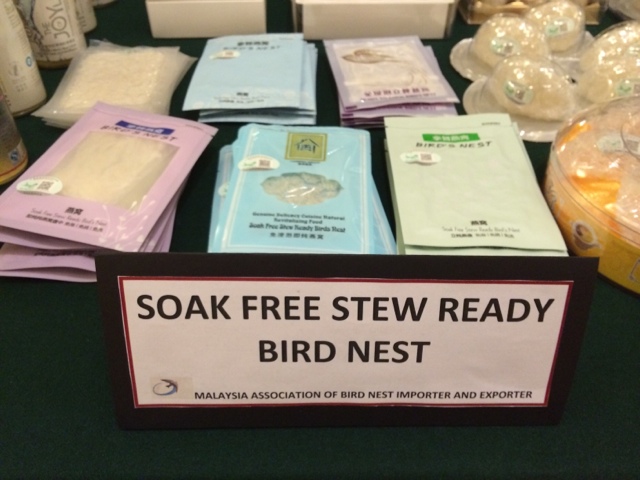


He said Malaysia hoped the number would continue to increase yearly, along the growth of local processing plants to producing export-quality edible bird’s nest.
“Edible bird’s nest is the most higly priced agricultural product in South-East Asia. It is estimated that there are more than 20,000 swiftlet ranching premises in operations throughout the country.
“The Department of Veterinary Services (DVS) has registered more than 10,000 swiftlet premises, and it expects to be able to register at least 90 per cent of the swiftlet premises by 2020,” Ahmad Shabery said in his opening speech at the 3rd Edible Bird’s Nest Industry Conference 2016 in Putrajaya on Tuesday.
The programme had received good response from a number of four- and five-star hotels which are willing to work together with the ministry to raise the awareness, he said.
The two-day conference beginning Tuesday was attended by 120 industry players mostly from Malaysia and China.
Themed “Empowering the Essence of Edible Bird’s Nest”, the conference serves as a platform to discuss the current developments of Malaysia’s bird’s nest industry; global issues and challenges; share experiences, as well as, research products; improve creativity and innovation of downstream products and promotion and marketing opportunities. - Bernama
Tuesday, October 11, 2016
Empowering the Essence of Edible-birdnest
More than 20,000 bird's nest premises will be registered by 2020 in Malaysia said YB Dato' Sri Ahmad Shabery Cheek, Minister of Agriculture and Agro-Based Industry, Malaysia. Bird's nest will replace shark's Fin in the food for future with the motto ' Empowering the Essence of Edible-birdnest'


Friday, September 30, 2016
Malaysia expected to export 130 tonnes of edible bird’s nest
KUALA LUMPUR: Malaysia produces some 350 metric tonnes of edible bird’s nest annually and around 130 tonnes are expected to be exported by the end of this year, said Department of Veterinary Services (DVS) deputy director-general (Veterinary Health) Datuk Dr Quaza Nizamuddin Hassan Nizam.
“The edible bird’s nest industry is growing and last year itself, the country has exported 105 tonnes of edible bird’s nest to various countries.
“We’re exporting some 12 metric tonnes in the form of raw, clean to China. We have a programme in progress where we’re trying to export raw, unclean to China.
“Only about 25% of edible bird’s nest production is going for further process value adding whereas about 50% goes under raw, unclean and 25% raw, clean. We’re trying to increase the 25% to 50% to make it value adding for more income and to penetrate more markets,” he told a press conference after the Swiftlet Eco Park Group 12th anniversary dinner.
Dr Quaza added that the Middle East, US and Europe differed from the Chinese market so industry players have to look at different ways of selling their products rather than just looking at raw, clean and raw unclean edible bird’s nests. The value of edible bird’s nest now is around RM7,000 per kg.
Dr Quaza stressed that all swiftlet farming premises were registered in the DVS system and a full traceability system is in place to ensure the bird’s nests from Malaysia are of good quality and can be traced to the bird house it came from.
“For example, when we export the bird’s nest to other countries, it has a special sticker with a pin number and a code which can be scanned and traced to its source.
“We want to ensure the importance of food safety from the farm to the table,” Dr Quaza said. Deputy Agricultural and Agro-Based Industries Minister Anthony Nogeh Gumbek, who was also present, said the bird’s nest industry is recognised as one of the high value industries and the Government has placed it under one of the entry point projects of the Economic Transformation Programme.
“We want to produce bird’s nests which are acceptable by any standard in any country and we want to value add it.
“We don’t just sell raw clean or raw unclean bird nest, you process it to downstream products where you can get more return from it,” he said, adding that Government has spent almost RM8mil for research funding to assist the industry to expand the product range.


Subscribe to:
Posts (Atom)